There is a particular kind of desperation that comes with lying awake at night, phone in hand, trying to find the right words for something you can feel but cannot yet fully explain.
You might be typing things like “Why do I feel anxious around my partner?” or “Why do I feel like I’m always walking on eggshells?” Perhaps you keep searching for explanations for why you feel guilty all the time, why you no longer trust your own judgement, or why you feel completely exhausted even though, on paper, there is nothing obviously wrong.
Sometimes you are not even sure what you are looking for. You are just hoping that somewhere, buried in the internet, there will be one sentence that makes you stop and think, Oh my God. That’s it. That’s what I’ve been feeling.
I know that feeling.
I know what it is like to spend years feeling as though something is wrong with you, to keep trying to fix yourself, calm yourself down, be less anxious, be less emotional, be more understanding, be more patient, only to eventually realise that perhaps your body was not reacting to nothing. Perhaps it had been trying to tell you something for a very long time.
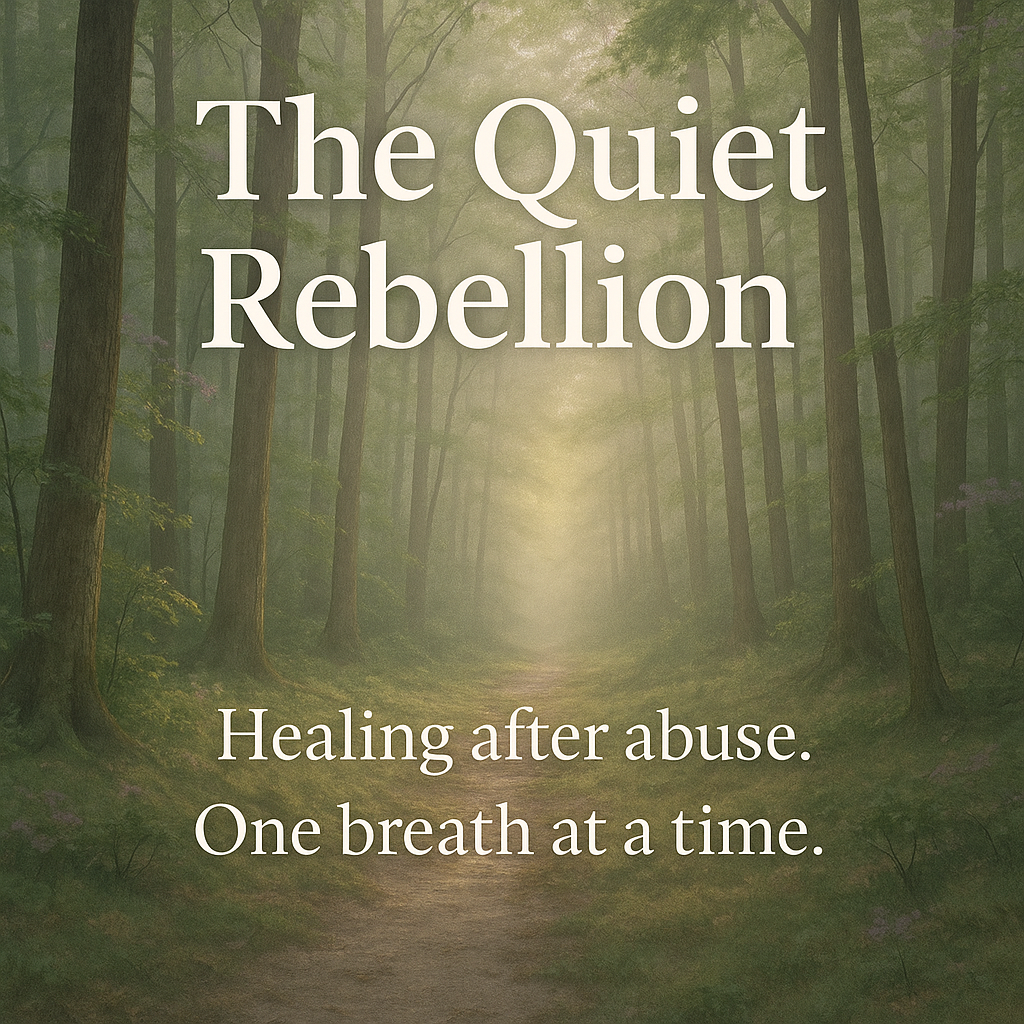
And that is why I created The Quiet Rebellion.
Not because I have all the answers, and certainly not because I have floated serenely through healing and come out the other side as some permanently calm, perfectly regulated version of myself. I created it because I know what it is like to be completely lost inside your own life. I know what it is like to question yourself so much that you no longer know what is real, what is reasonable, or whether you are somehow the problem in every situation.
This is the place I wish I had found when I was the one searching.
⸻
Sometimes You Know Something Is Wrong Long Before You Understand What It Is
Emotional abuse and manipulation can be incredibly difficult to recognise when you are living inside them, especially when there is no single dramatic event that you can point to and say, There. That was the moment everything changed.
More often, it can happen through hundreds or thousands of small moments.
You start choosing your words more carefully. You notice changes in someone’s mood before they have even spoken. You stop bringing certain subjects up because you already know where the conversation will go. You explain yourself more than you should have to. You find yourself apologising for things you are not even sure you did wrong.
Gradually, you can become so used to managing the atmosphere around another person that you barely notice how much energy it is taking from you.
That was one of the hardest things for me to understand. From the outside, so much of life can still look completely ordinary. You can be working, raising children, making dinner, going shopping, answering messages and carrying on as though everything is fine, while inside you are constantly braced for something.
And when you live like that for long enough, you can forget what it ever felt like not to be braced.
You might begin to believe that anxiety is simply who you are. That you are naturally difficult, oversensitive, insecure or incapable of coping with normal life.
But sometimes anxiety is not appearing out of nowhere.
Sometimes your body has spent years responding to an environment that did not feel emotionally safe.
⸻
You Are Allowed to Take Your Own Experience Seriously
One of the biggest changes in my own healing came when I stopped asking myself whether what happened was “bad enough” and started paying attention to what it had actually done to me.
Because you can lose years trying to prove your experience.
Was it really abuse?
Was it intentional?
Did they mean to hurt you?
Were they just stressed?
Were you too sensitive?
Could you have handled things differently?
You can disappear down those questions forever.
And while you are busy analysing the other person, you can completely overlook yourself.
The exhaustion. The confusion. The anxiety. The way you stopped trusting yourself. The way your body seemed to be constantly waiting for the next problem. The way you became smaller and quieter without even realising you were doing it.
You do not have to have every label figured out before you are allowed to acknowledge that something hurt you.
You do not need the person who hurt you to agree with your version of events.
You do not need everybody around you to understand.
Your experience still matters.
⸻
Your Body Might Be Telling a Story Your Mind Has Not Fully Caught Up With Yet
For years, I thought there was something physically wrong with me.
I felt exhausted. Anxious. Unwell. My body seemed to be struggling constantly, yet tests would come back normal and I’d be told that everything looked fine.
But I did not feel fine.
That disconnect is something I understand very differently now.
When you have spent a long time living in stress, fear, confusion or hypervigilance, your body can become incredibly good at anticipating danger. You notice tone changes. Facial expressions. Silence. Small shifts in atmosphere that other people would not even register.
You become alert because, at some point, being alert helped you cope.
The problem is that your body does not always instantly relax simply because your circumstances change. You can understand intellectually that you are safer now while still feeling jumpy, anxious, exhausted or unable to switch off.
That does not mean you are failing at healing.
It means your body learned survival very thoroughly, and now it may need time and repeated experiences of safety before it begins to believe that it no longer has to be on guard every minute of the day.
This is the part I wish more people talked about, because healing is not simply deciding that you are fine now.
Sometimes you know you are safe, but your body still does not feel safe.
You desperately want peace, but peace feels unfamiliar.
Sometimes the first moment you finally slow down is the exact moment everything you have been holding together begins to surface.
There is nothing weak about that.
⸻
Perhaps You Are Only Just Beginning to Question Things
You might be reading this while you are still in the relationship.
You might have left years ago.
You might not even be sure whether the word abuse belongs anywhere near your experience.
That is okay.
You do not need to force yourself into an answer before you are ready.
The Quiet Rebellion is not here to tell you what your story is. It is here to help you explore the things you may have been feeling for a very long time and give you the words you might not yet have had.
You may recognise yourself in articles about walking on eggshells, trauma bonds, emotional abuse, chronic stress, nervous system dysregulation or losing trust in yourself.
You may read something that fits perfectly.
You may read something that does not fit you at all.
Take what helps.
Leave what does not.
This is your story, and you are allowed to understand it in your own time.
⸻
If you are trying to make sense of an emotionally harmful or confusing relationship, start here:
The Thousand Tiny Cuts Nobody Else Can See
What Do You Say When Someone Asks, “What Did He Actually Do?” Understanding Covert Emotional Abuse
What Is Wrong With Me? The Question I Googled Before I Realised I Was Being Abused
⸻
Maybe You Left, But Somehow It Still Hasn’t Ended
Leaving is so often spoken about as though it is the finish line.
You leave, you are free, and then you heal.
But for many people, particularly when there are children, finances, property or legal matters involved, life is nowhere near that simple.
Sometimes the relationship ends and the abuse simply changes shape.
The control moves into messages. Parenting arrangements. Money. Property. Smear campaigns. New partners. Court proceedings. Endless practical decisions that keep dragging you back into contact with someone you are desperately trying to detach from.
And when that happens, it can be incredibly lonely.
People may wonder why you are still upset.
They might ask why you do not simply ignore it.
They may tell you that you should be happy because you have left.
But leaving someone physically does not automatically remove their ability to create chaos in your life.
You can be free from the relationship and still dealing with the aftermath of it.
You can be rebuilding your life while somebody continues to destabilise it.
You can be relieved to have left and still feel completely exhausted by what came afterwards.
I think both truths deserve to exist together.
If leaving did not bring the peace you expected, you may want to read this next:
Post-Separation Abuse: Why Leaving Didn’t End the Abuse
⸻
Maybe the Hardest Part Is That You Don’t Feel Like Yourself Anymore
This is something I think people often underestimate.
Abuse does not only change the way you feel about the person who hurt you. Over time, it can quietly change the relationship you have with yourself.
Confidence gets chipped away. Decisions become harder. Instincts are second-guessed. Having needs can start to feel selfish, and after spending so long thinking about everybody else, it can become strangely difficult to work out what you actually want.
Then freedom arrives, but it does not always feel immediately freeing.
Suddenly there are choices to make, boundaries to set and a whole life to rebuild, yet the part of you that once knew what felt right may have been ignored, criticised or drowned out for so long that trusting yourself again feels unfamiliar.
I think this is one of the strangest parts of healing.
It is not simply about recovering from what happened. It is also about slowly getting to know yourself again.
Learning that peace does not have to be earned through perfect behaviour.
Learning that a boundary is not cruelty. Learning that having needs does not make you difficult.
And perhaps most importantly, learning that your own judgement is worth listening to again.
That part can take time, but I honestly believe it is one of the most powerful parts of healing. Because eventually life stops being shaped entirely around what will keep everybody else comfortable.
Slowly, your own voice starts to come back into the room.
At first it might only be in small ways. A preference. A boundary. A decision made without asking whether somebody else will approve.
But those small moments matter.
They are how trust in yourself begins to grow again.
⸻
You Don’t Have to Work Everything Out Tonight
Maybe you came here looking for one clear answer and somehow ended up with a hundred more questions. That is okay.
Nothing has to be solved in one night. There is no deadline for understanding what happened, no pressure to read every article, and no requirement to have yourself neatly figured out before morning.
The Quiet Rebellion is here for the messy middle as much as anything else. The confusion. The anger. The grief. The moments where the body still feels stuck in survival mode long after the danger has supposedly passed.
Sometimes the biggest shift is simply beginning to realise that perhaps you were never as broken as you were made to feel.
This space is about making sense of what happened, learning to feel safe again, rebuilding trust in yourself, and slowly finding your way back to a life that feels like your own.
Welcome to The Quiet Rebellion.
I’m really glad you found your way here.
With love,
Lisa
The Quiet Rebellion 🌿